Tuesday, October 23, 2012

32 BBY: Podracing Tales


As taken from Wookieepedia:

“Podracing Tales was an online comic published on StarWars.com on December 19, 2000, as "a special holiday treat" for fans, courtesy of the Official Star Wars Website and Dark Horse Comics. It consists of eight vignettes featuring the Boonta Eve Classic podracers from Star Wars Episode I: The Phantom Menace.”

Written by Ryder Windham, Podracing Tales did well weaving itself into the peripheral threads of the Episode 1 comics.  Though I didn’t enjoy the art of this piece, the eight fragments were mildly enjoyable simply as bits of text supporting and referencing a larger and earlier text.  Its two major points of familiar subplot from the Episode 1 comics were its reference to the Sebulba assassination plot, and the fact that Sebulba bought Anakin’s old podracer.
In Podracing Tales the scene between Aldar Beedo and Wan Sandage elucidates a little more on the original scene of the two found in Anakin Skywalker’s Episode 1 comic.  Its purpose supports the idea that Wan Sandage is indeed a killer, and references his previous job killing Borzu Nale, a minor crime lord.  There is a disparity between the price the two negotiated to kill Sebulba.  In the Episode 1 Comic the two racers agree to a sum of 50,000 “wupiupi”; whereas in Podracing Tales the two agree to a sum of 200,000. 

Also, at the end of Podracing Tales we see Sebulba with his new podracer and his pledge to head to Malastare.  This scene links with Qui-Gon’s Episode 1 comic, where he sells Anakin’s racer to raise money for the boy’s mother.

Beyond these two aspects of intertextuality, I thought it neat that the racers of the Boonta Eve Classic were all out with each other the night before boozing it up. 

Texts influencing and referencing other texts; one of my favorite aspects of the Star Wars expanded universe. 
For my next post I’m going to take a look at Galactic Battlegrounds missions 2 and 3, thus starting a three-post video game run.  Until then my friends, may the Force be with you.

Monday, October 22, 2012

32 BBY: Episode I storybooks: Watch out Jar Jar!/ I Am a Jedi / I Am a Droid/ I Am a Pilot/ I Am a Queen


Like a lot of the children’s material I’m looking at for my PhD in Star Wars-ology, the pre-school books Watch out Jar Jar, I Am a Jedi, I Am a Droid, I Am a Pilot, and I Am a Queen are fairly insignificant bits of text in the grand scheme of my plan.
Beyond a neat cross section of a lightsaber, and a photo of Darth Sidious where you can actually see his eyes in I am a Jedi, and  a picture of Queen Amidala’s Royal Advisory Council  in I am a Queen, where we are presented with the  names and titles of her advisors, like Graf Zapalo, Master of Sciences, these books are forgettable.

There was a lovable looking droid in I am A droid named Rolo that reminded me of WALL-E (I wonder if Rolo played some inspiration in the creation of that Disney character?), but otherwise the other two books held nothing of importance.

As it is, I’m moving on to Podracing Tales next, then on to a few video games which I’m looking forward to.  I’m still here, just bogged down in teacher stuff.  Until then my friends, may the Force be with you.

Tuesday, October 9, 2012

32 BBY: Episode I: Anakin’s Fate/ Dangers of the Core/ Jar Jar’s Mistake/ Anakin’s Pit Droid/ Darth Maul's Revenge/ Anakin to the Rescue/ Anakin's Race for Freedom


The Star Wars Episode 1 children’s books featuring the titles: Anakin’s Fate, Dangers of the Core, Jar Jar’s Mistake, Anakin’s Pit Droid, Darth Maul’s revenge, Anakin to the Rescue, and Anakin’s Race for Freedom were no more interesting than the last series of children’s books I looked at.  Of the seven I’ve just mentioned, the most interesting were Darth Maul’s Revenge, Anakin to the Rescue, and Anakin’s Fate.
The other four titles generally stayed inside the narrative of The Phantom Menace with the exception being Dangers in the Core.  It included within its pages the cut-scene of Qui-Gon, Obi-Wan, and Jar Jar’s escape from the bongo before it fell over the Theed waterfall. Anakin’s Pit Driod contained a cute narrative of DUM-4, and Anakin’s Race to Freedom featured some good art by Jose Miralles, but that is really about it.

The only thing really interesting about Darth Maul’s Revenge was that its narrative contained the story of Maul being attacked by the Tusken Raiders found in the Journal of Darth Maul. Tommy Lee Edward’s illustrations of Maul facing off with the Tuskens was good. 

Anakin to the Rescue was the most original of all the stories.  Surprisingly, this was a touching little tale about Anakin helping a lost boy named Finn on Corusacant. Finn, a boy of about 5 or six years old, became lost because his nanny droid went haywire.  Anakin agreed to help the boy, and the droid lead Anakin, Jar Jar, and Finn on a wild chase through the streets of Coruscant.  They finally caught up with the droid wherein Anakin fixes it.  Anakin and Jar Jar make it back to the temple before the Qui-Gon and Obi-Wan depart for Naboo.  Anakin then explained to Qui-Gon where was and what he was up too.  Qui-Gon nods and gives Anakin some fatherly approval.  Chris Trevas was the artist in this story, and I always enjoy his work.
Anakin’s Fate was the most enjoyable of the seven books I looked at.  Interestingly, is that Quinlan Vos in the background on page 9?  I’ve often wondered about this.  What was Quinlan Vos doing on Tatooine when Qui-Gon and Obi-Wan were there?  Someone please tell me if that backstory was eventually filled in.  Qui-Gon was steps away from Quinlan, but there was no interaction.  We know why this is; because the Quinlan Vos we see in the Phantom Menaced is not yet known to be the Quinlan Vos from the EU. The naming of the “man at the cafe with the yellow stripe across is face” came later.  But again I ask: is this narrative later addressed?

The art was great in this book.  My favorite scene was from pages 18-19, where Anakin and C-3P0 are speeding across the dessert carrying scrap to trade with the Jawas.  In the background are the scraggly cliffs of Tatooine framed by the two suns in the sky.  There are some banthas over the horizon and Tusken raiders raising their arms in protest.  In the foreground is the skeleton of a kryat dragon.   It’s a shame Marc Cerasini left out the part about Anakin helping the wounded Tusken Raider on his way back from trading with the Jawas.  In the novelization of The Phantom Menace I thought this whole scene was the best part.
Also included in this story was Anakin’s conversation with the old spacer (though in this book he didn’t look very old and he was presented differently than the “old spacer” from the Episode 1 comics) and the bit about the kids getting fruit drinks. However, there is a bit of a continuity error in this story.  As found on Wookieepedia: “This story goes over the race that Watto refers to in Episode I where he says, "He smashed up my pod in the last race!" It also contains a major continuity error. Anakin flies Watto's pod, which looks exactly like his own pod that he flies in Episode I despite the fact that his racer was unfinished and under construction at the time”. 

I’ll be glad when I can put these children’s books behind.  As I’ve said before, being a completionist is mildly insane.
Sorry for the long period between posts.  As you’re well aware of by now, when September rolls around and the new school year begins all my free time goes out the window.  What free time I do have after the children go to bed is wasted in front of the TV where I get to shut off my brain.  My ability to concentrate in the evenings is horrendous.  This post took forever to write.

As it is, I’m one step further out of 32 BBY.
For my next post I’m going to take a look at more Episode 1 storybooks.  Until then my friends, may the Force be with you.

*** Is anyone else seeing random words highligted in my post with an add?  This is not my doing and how do I make it stop?

Monday, September 17, 2012

32 BBY: Star Wars Junior: Droids Everywhere / Jedi Escape/ Obi-Wan’s Bongo Adventure/ Catch that Pit Droid!/ Podrace/ C3PO’s Big Adventure/ Sith Attack/ Meet the Jedi High Council/ Droids to the Rescue/ General Jar Jar/ Gungan Trouble/ Save Naboo


Before I start with my reactions to the Star Wars Junior series I want to thank Plaristes.  Without him I would’ve had a much more difficult time getting a hold of these books. So, thank you sir.  Your record keeping has made my trek through Star Wars chronology much easier.
Though there are twelve books in the series, I already dealt with Droids Everywhere back in February so my post today will focus on the other eleven.  And really, there isn’t much to say about them. They are adaptations of the film that rarely travel outside the already established narrative of The Phantom Menace.  The books that did were the most enjoyable, namely Catch that Pit Droid, and Gungan Trouble. 

In Catch that Pit Droid Watto and Anakin chase a runaway pit droid through the streets of Mos Espa, while in Gungan Trouble we are privy to the Gungans packing up their belongings and heading to the “sacred place” where Jar Jar later finds them.  This scene raised an interesting question for me, and something that has bothered me about the background scenery of Naboo for some time.  Why does the “sacred place” contain human looking heads, if the Gungans view the Naboo (humans) suspiciously?  A little investigating on wookieepedia answered this question for me.  It seems as though the large stone heads on Naboo are carvings of The Elders, an ancient race who colonized Naboo many millennia before.  Apparently the Gungans consider them their “guds”.  If I didn’t know any better at first glance I’d say the Gungans were Buddhist, what with all their old statues of Buddha lying about.

As it is, of all the books I examined the one I enjoyed the most was Meet the Jedi High Council.  I’m glad the writer Laura Dower didn’t feel the need to make every bit of Yoda’s speech backwards talk. Also, who knew Ki-Adi Mundi had two hearts to work his large brain and Yarael Poof smelled with his hands?  However, what most stood out to me most in this book was Depa Billaba, a member of the Jedi High Council we almost never hear about.  So far she’s only appeared few times in Star Wars chronology: in the comic short Children of the Force with her master Mace Windu, and in Jedi Council: Acts of War.  In both stories she was a forgettable, which I think is unfortunate because she seems like a really interesting character.  I hope she’s flushed out a bit later on in Star Wars history.  It’d be nice to know a little more about her.
The best part of all these books was the art, and the artist I enjoyed the most was Jerry Vanderstelts.  His work was the most detailed and rich.

For my next post I’m going to look at more Star Wars children’s books.  Until then my friends, may the Force be with you.

Thursday, September 13, 2012

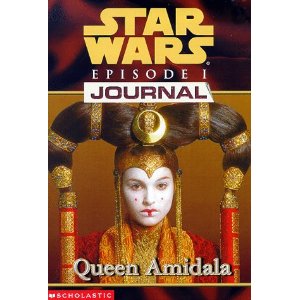
32 BBY: Episode 1 Journals: Queen Amidala, Anakin Skywalker, Darth Maul


When I began reading the Episode 1 Journals I decided to engage with them in a specific order.  I started with the Queen’s journal, followed by Anakin’s, then ended with Maul’s.  I read them in this order because I anticipated I’d enjoy the Queen’s journal the least and appreciate Maul’s journal the most. My instincts were correct.
The Queen’s journal was the dullest of them all.  Both the Queen’s Journal and Anakin’s journal followed as a first person narration of the events of The Phantom Menace.  But Maul’s journal contained some unique elements not found in the film.

Though I found the Queen’s journal the dullest there were some small aspects of the story that were interesting.  For instance, we discover that the fate of King Veruna is farming rocks in the Naboo Wasteland (pg 8), that Padme wonders if Sabe enjoys ordering her around (28), and that Padme recalls some sage advice from her grandmother Winama (43).  There was also a great little bit about her amulet:

“Then I slipped off the amulet I always wear around my neck.  My parents gave it to me when I left to take the Governorship of Theed.  It’s a stone my father found on out land.  My mother fashioned the clasp” (17).
I love it when two sources intersect.  In this case, Julianne Balman’s The Queen’s Amulet with Watson’s adaptation. This is but another example of texts influencing texts.

Anakin’s journal was much the same as the Queen’s, but there were some small jewels of interest to be found in the monotony of the narrative.  Interestingly, Watson makes reference to extra-galactic visitors to Tatooine, which I think is something that is inconsistent with the over-arching mythos of the Star Wars universe:

“A bunch of hyperspace trading routes meet here on Tatooine.  This means we get visitors not only from our galaxy, but other galaxies as well” (10).
This could be the case, but it was my understanding that the Yuzzhan Vong were the first extra-galactic visitors to Anakin’s galaxy. Someone correct my understanding here.

Also, in Anakin’s journal it is the first time there is any hint that his dreams end badly:

“But I had another secret as well.  A dark secret.  It was about the way my dreams always ended.  It was a secret that frightened me, one I could never tell” (21).
In The Phantom Menace and other adaptations we are only told Anakin’s dreams consists of either him becoming a Jedi and freeing the slaves, or Padme leading a large army into battle, but there is never any hint of anything ominous about them. I wonder what exactly Anakin sees?  Is it the near murder of his wife by his own hands, or perhaps his slaughter of the innocents in the temple?  Curious.

There was a humorous echoing of Return of the Jedi in Anakin’s journal, one which forces us to imagine Padme in a slave-Leia costume:

“I knew if I lost the race, Qui-Gon, Padme, and the others might be stuck on Tatooine for a long time. And when you were young and pretty on Tatooine, it wasn’t long before you belonged to Jabba.  To imagine Padme chained like a slave made my blood boil” (29).
It’s probably not a terrible image for the slave-Leia costumes lovers out there.

The most interesting aspect of Anakin’s journal was his mention of an ancient war-droid and the story of the first time he heard the word “Sith”:

“I was looking for something in Watto’s junk heap when I came across an old war droid.  This unit was really ancient…I was in the middle of testing the projector when the holograph burst on.  It showed some kind of ancient battle… I could hear screams and grunts and panicked shouts.  Something about the Sith this and the Sith that” (72-73).
There is a lot going on in this passage.  Firstly, I’m curious to know what sort of war droid Anakin has in front of him.  Was it a Mark 1 or Mark 2 war droid from the time of the Sith Empire in 3600 BBY, or was it something else, maybe something along the lines of Xim’s Guardian Corpsdroids?  Here lies the kernel of yet another short story: how did this ancient droid come to be in Watto’s junk heap?  Secondly, which battle is going off here?  Is it the sacking of Coruscant, or maybe something more ancient, perhaps the razing of Korriban at the hands of the Republic in 5000 BBY?  Maybe it was from one of the many battles of Ruusan circa 1000 BBY?  As it is, I found this to be the highlight of Anakin’s journal.

Like I said in my introduction, Maul’s journal was the most entertaining.  At least half of Maul’s journal contained events not found in The Phantom Menace.  His journal starts off well:

               “You may think I am evil.  I am not.  I am efficient” (1).
It is almost a universal trait that evil people don’t believe themselves to be evil, and Maul is no exception.  Actual evil people see themselves as “practical”, “pragmatic” or “reasonable”.  They see themselves as problem solvers.  Take Hitler for example: from his point of view he was simply trying to solve the problem of Germany’s troubled economy.  His “pragmatic” response was to kill Jews, Gypsies, Homosexuals, and a myriad of other people he felt were part of the problem and not part of the solution. In his mind he was being “pragmatic”.  Though I haven’t read Mein Kampf, I wouldn’t be surprised if somewhere within its pages one could find a line like: “What I am proposing is not evil, but simple efficiency”.  Evil people never consider themselves to be evil because to consider such a thing would mean to deeply question their worldview and strongly held convictions.  Maul would never do such a thing.

Though I enjoyed Maul’s journal, I thought the idea of Maul keeping a journal rather silly.  I can believe the Queen and Anakin doing it.  Perhaps it would have been more immersive had Maul’s first-person narrative been in the form of a Sith holocron, following in the ancient tradition of his precursor Darth Bane.  On that note, I thought it neat that Maul made some oblique references to Darth Bane:

“But the last Sith was the smartest of all.  It was he who devised the brilliant strategy that has kept us secret for a thousand years and allowed us to grow in the shadow of the dark side” (18-19).
The holocron of Darth Maul would be neat to examine, but I’m sure the construction of such a delicate device would be a skill that is unreachable for him (considering how difficult it was for Bane).  Sidious was only interested in training Maul for combat, not in furthering his knowledge of the dark side of the Force.  It’s apparent that Sidious really did not want an apprentice, despite what he says.  Though Sidious may claim Maul was his apprentice, he really wasn’t.  Maul was simply his abused and fanatic child, which brings me to the topic of his childhood.

Maul’s upbringing was abusive and cruel, and makes me feel sympathy for him (which in turn makes him a more interesting character).  The story of the dinkos was particularly malicious, but the worst story of all was his mention of learning to cry no longer:

“A child cries when his belly is empty, when he hears a food cart rattle by his door, smells his dinner, and yet the food cart rolls on.  He does not understand that this pain makes him stronger…I soon learned not to cry” (19).
Of all the stories of Maul’s upbringing, this one made me feel the saddest for him.

Along with Maul’s recognition that crying would do him no good, he also conjectures that perhaps his parents, after losing him, may have gone searching for him:

“I was found by my Master and taken as a baby.  My parents might have looked for me” (17).
Though this scene may no longer be canonical, knowing what we known from the Nightsister trilogy from The Clone Wars (that Maul was residing on Dathomir with his brother Savage), it’s still a depressing picture to imagine.  Here we have two Iridonian parents searching for their kidnapped newborn – a beautiful child full of force potential, ripped from his parents’ loving arms.  Both of these stories broke my heart.  Was Darth Bane ever this cruel to Zannah? Truly the dark side is disgusting and profane.

Moving on in my reactions, it was Jude Watson who penned this narrative and I always enjoy Watson’s work.  Written in 2000 Watson came eerily close to describing the destruction of the Jedi temple found in Revenge of the Sith, a narrative not created until 2005:

“I strain my eyes, but the Jedi Temple is not visible from this viewpoint.  I imagine it instead.  I see a smoking ruin, a blasted shell.  The bodies of fallen Knights and Masters are littered around it.  I stand on the rubble before my Master” (11).
The only difference between Maul’s vision (Watson’s description) and the event from Revenge of the Sith is the person standing over the bodies.  How strange that it was the boy from the dessert of Tatooine that Maul ignored, not him, who was standing over the bodies of the Jedi.

Two other enjoyable scenes were the Torgorian space pirate incident, and Maul’s lightsaber duel with Sidious.  These were narratives which made the book worthwhile to read. There is also this great accidental reference to Loran Pavan (at least I think it’s an accidental reference):

“I focus on the darkness within.  I start to imagine a battle fought on a mission for my Master.  I don’t remember my opponent’s face, but I remember how he fought.  I remember how he tried to elude me in the end, and how I ran him down” (58).
It’s conceivable Maul is making reference to something else here, but it’s also possible he is making reference to the Lorn Pavan incident from Shadow Hunter.

Finally, my last bit of commentary centres upon Sidious’ comment on Maul’s demise:

“My worthy apprentice failed me in the end.  He fell into the melting pit.  I am glad, at least, that his body was consumed.  If there must be an end, it is a fitting one” (95).
The dark side of the Force is a pathway to many abilities some consider to be un-natural.  The more I reflect on the return of Maul, the more I appreciate what Filoni has done.  I also have Wallace’s Book of the Sith sitting on my bookshelf, and I can’t wait to get to it because I think it comments on how Maul survived his fall, and how, contrary to what Sidious believes, was not “consumed”. Apparently Maul was more versed in the dark side than we thought.  Maybe he was even studying things he should not have been behind his Master’s back.  Maybe, somewhere down the line, he was planning to kill his Master, and become the true Dark Lord of Sith.  Maybe Maul deserves a second chance.

For my next post I’m going to take a look at the Star Wars Junior series.  Until then my friends, may the Force be with you.

Tuesday, August 28, 2012

32 BBY: Battle for Theed


The Battle for Theed is the first of its kind: a comic based on a Star Wars RPG.  Though it’s only three pages in length I found the concept neat enough.  You can find the comic at the bottom of the page here (thanks Plaristes).
I can see the Darkhorse publication now: Star Wars RPG Adventures. Each adventure is played by guest RPG’ers like Stackpole, Anderson,  Zahn, and Karpyshyn.  At each session there is a secretary recording the events and an artist sketching out the adventure as it unfolds.  Bill Slavicsek is, naturally, the GM.  What an RPG lover’s dream!

The Battle for Theed is a source with minimal story, but the creation of an in-depth narrative wasn’t its purpose.  Its purpose was to excite new role-players to the re-booted Wizards of the Coast RPG product.  This little comic was totally awesome and a total gem.  Daniel Veesenneyer’s art was fantastic.  I truly love the art found in RPG materials of any kind. 

Interestingly, this story is written my Michael Stackpole who is mostly known for his work on the X-Wing series (to me anyway).  Who knew he also worked on Dungeons and Dragons back in the late 70’s?  I certainly didn’t.  It defiantly increases my opinion of him.  I love that he’s a Star Wars author who’s also a gamer. 
As it is, I’m excitd to find out what happens to Deel, Arani, Sia-Lan, and Rorworr as they passed the security door and into the room of the unknown.  I suppose the end of this story will come in the Invasion of Theed RPG package.  Unfortunately it’ll be a while before I get there.  There is still lots to look at in the year 32 BBY.

For my next post I’m going to look at the Journals of Anakin Skywalker, Queen Amidala, and Darth Maul.  Until then my friends, may the Force be with you.

Monday, August 27, 2012

32 BBY: Secrets of Naboo Sourcebook


Reading Star Wars RPG sourcebooks is a guilty pleasure of mine.  What I love most about the Star Wars Chronology Project is that it affords me the excuse to sit down and read an RPG sourcebook cover-to-cover.  If I wasn’t on this quest there is no way I’d simply sit down to read a sourcebook.  I’m not sure I could justify to myself such an expenditure of time.
As I’ve mentioned before in my other posts on RPG sourcebooks, what I love about them is that they offer the nitty-gritty details of the Star Wars universe.  They contain information that would otherwise be difficult to inject into a regular narrative like a novel or comic.  From this particular source as an example, there is this great explanation from the Trade Federation Technology section on the cost benefits of having a droid-controlled ship over having droid brains that operate independently.  Essentially the Trade Federation was saving millions of credits using the droid controlled ship because they never believed the ship’s defences could be breached.  But the most important thing I walk away with from this source is that this narrative even exists.  In what manner can an author effectively introduce dialogue between Nemodians as they decide how to set up their droid army?  I think a sourcebook is the best way to do this. 

I walked away from this source respecting the Trade Federation a little more, and basically having an overall higher opinion of battle droids.  The obvious benefit of a droid army is strength in numbers.   If they don’t come into contact with Jedi and are facing a regular standing army of beings they should be able to overwhelm their opponents into defeat.  What I never knew before is that battle droids are designed to be salvageable in order to re-deploy into the theatre of operations. 

“After a battle, cleanup droids gather the spent parts from the field.  Workers in properly equipped shops can then reassemble the undamaged modules into working droids.  In this way the Trade Federation can recover a majority of the droids who fell in combat, thus maximizing its investment in the manufacturing process” (11).
Here the Nemodians have taken a page from American military history.  Utility is the key to victory. Tank parts should be able to work in Jeep parts, and vice versa.  Any good military should be able to recover equipment from the battle field and reprocess into the theatre once more.  It’s simply a combination of good economics and military strategy if you ask me.  Like I said, my opinion of battle droids, and the Nemodians, increased a little. A wounded soldier takes precious resources to rehabilitate.  A droid requires only some welding and re-wiring.

Weapon stats are another feature of sourcebooks I enjoy.  Though I’m still unfamiliar with the inter-workings of the D20 system, figuring out which weapon is the most powerful is pretty simple.  In this sourcebook that honor goes to the Naboo S-5 Heavy Blaster Pistol with a damage output of 3d8 plus a 1d2 paralytic poison – Captain Panaka’s weapon of choice, naturally.  The artwork for the guns was pretty neat as well.
As far as story goes, the most important aspect of this text is the RPG scenario Peril on Naboo, but before I get to that I want to mention a tiny piece of narrative which, had I been lack in my reading, I might have missed.  In the section on Green Glie there is this strange little tidbit of narrative about the poisonous nature of the algae.  It starts with an advisory note at the end of the explanation of Green Glie:

“Advisory Note: All Jedi who visit Naboo should be extremely careful when accepting hospitality from even the most trustworthy individuals.  The Council is still investigating the death of young Jedi Knight Keiran Valn on Alderaan last month.  Preliminary reports indicate that he died by ingesting a glie-derived compound at a banquet held by his own family” (52-53).
When I first read this I thought it was a reference to another story somewhere else in the EU, but this is not the case. After looking through wookieepedia it’s apparent that this story is only found in the Secrets of Naboo sourcebook.  This narrative is curious because it raises some fascinating questions.  Firstly, why is this Jedi visiting his family?  Is there a Xanatos element going on here, where he has been called to his home planet on a mission and faced with his family to test his dedication to the Jedi Order?  What has this Jedi done to warrant an assassination?  Why would his family kill him, if indeed they are responsible?  For you short story writers out there, here is a great hook to explore the demise of Keiran Valn.  This story has yet to be explored and is opened to anyone creative enough to fill in the blanks of Valn’s murder.  Maybe the protagonist could be a Jedi investigator and the story could have a CSI type ‘whodunit’ element.

My last point of discussion centres upon the RPG adventure Peril on Naboo.  Taking up almost half of the sourcebook this RPG scenario is one of the largest I’ve read.  The adventure is separated into three parts with three scenarios per part.  It starts with a group of level 1 to 2 heroes stranded on Naboo as the Trade Federation invades.  The heroes come together to save the daughter of a tramp freighter by trying to smuggle out of Theed some medical supplies.  Needless to say events transpire against them, and the heroes are forced to fight battle droids and join the Naboo resistance movement.  The adventure ends with the heroes assisting Queen Amidala’s in her plans at the end of the film, with all the major players of the Phantom Menace making an appearance.  It was truly an epic adventure.
Star Wars RPG sourcebooks makes the Star Wars universe better.

For my next post I’m going to take a look at the 3-page RPG comic, Battle for Theed, from Wizards of the Coast.  Until then my friends, may the Force be with you.